Bedding · Sleep surfaces
Dunlop or Talalay Latex: Understanding Feel, Support, and Resilience
Latex has a particular kind of presence in a bed: buoyant rather than sinking, responsive rather than slow to move. Yet “latex” is not a single feel. Dunlop and Talalay describe two manufacturing processes, and the differences between them can shape the way a mattress or comfort layer responds beneath you. Here is how to compare them—with attention to the whole sleep surface, not just the name on a label.
First, what does “latex” mean?
Latex used in bedding is a resilient foam made by processing rubber. It may be produced from natural rubber, synthetic rubber, or a blend; the material source and the method used to turn it into foam are related but distinct questions. Dunlop and Talalay refer to those methods. Neither name, on its own, tells you whether a product is natural, organic, blended, or certified to a particular standard. For that, check the product’s material description and any relevant certification details.
In a mattress, latex may form the main comfort layer, a deeper support layer, or one component in a hybrid design that also uses coils and other materials. In a topper, it provides an additional layer over an existing mattress. The sensation you experience depends on the latex’s firmness and thickness, but also on the layers around it, the cover, the base, your body shape, and how you sleep.
That context matters because the familiar comparison—Dunlop is firmer, Talalay is softer—can be a useful starting point, but it is not a rule. Both processes can produce latex in different firmnesses. A specific Dunlop layer may feel more accommodating than a particular Talalay layer, or vice versa. Construction details and personal preference matter more than a shorthand ranking.
How the two processes differ
Dunlop: a direct, compacted process
In the Dunlop process, liquid latex is whipped into foam, poured into a mold, and heated to set. The resulting material is often described as having a denser, more substantial or grounded feel. Because the foam can settle during manufacturing, Dunlop latex may have a subtle variation in density through its depth. That description is a general tendency, not a promise about the sensation of every Dunlop mattress.
Some sleepers appreciate the steadiness they associate with Dunlop. It can feel supportive and relatively planted, qualities that may appeal to people who prefer less of a floating sensation. But the word “supportive” should not be mistaken for “right for every body.” A layer that feels stable to one person may feel too firm to another, particularly if it does not allow enough cushioning around pressure-sensitive areas.
Talalay: a more controlled, aerated process
Talalay latex is also foamed and molded, but its process includes additional steps. The mold is not filled completely; the latex is expanded to fill it, then frozen and vacuum-sealed before it is vulcanized. This production method is often associated with a more uniform, airy feel and a lively, buoyant response. Many people describe Talalay as softer or more springy, although, again, firmness options vary.
That lively response can make it feel easy to shift positions: the surface tends to push back promptly rather than retaining a deep impression. Some sleepers enjoy this gentle lift; others prefer the denser sensation they associate with Dunlop. Neither response is inherently superior. The useful question is whether the surface lets you settle comfortably while still making movement feel natural.
Manufacturing descriptions help explain why two latex layers may differ, but they cannot substitute for a clear specification. When comparing products, look for the stated firmness, layer thickness, material composition, and construction. If those details are not provided, the process name alone may leave important questions unanswered.
Feel, support, and resilience: three different considerations
These terms are sometimes used as if they mean the same thing. They do not. Understanding the distinction makes it easier to read product descriptions—and to focus on what you actually want from a sleep surface.
- Feel is your immediate impression: plush or firm, buoyant or grounded, cushioned or close to the surface. It is subjective and influenced by the entire mattress.
- Support describes how the sleep surface holds your body in a comfortable position. It is not simply a question of firmness. A very firm surface is not automatically more supportive, and a soft surface is not automatically unsupportive.
- Resilience refers to how readily the material responds and returns after pressure is applied. Latex is generally known for a responsive feel, though the sensation varies with the formulation, density, firmness, and surrounding layers.
Imagine lying on two beds with the same listed firmness. One might have a thin latex comfort layer over a firm base; the other might place a thicker latex layer above a more yielding support system. They can feel quite different. A quilted cover, wool or cotton padding, and a mattress protector can also soften or alter the first impression at the surface.
For this reason, a mattress label cannot tell the whole story. Firmness labels are not perfectly standardized across manufacturers, and individual perception is shaped by body weight, proportions, sleep position, and personal history with different materials. A specification is a guide to construction—not a guarantee of comfort.
How sleep position can guide your comparison
Sleep position offers a practical lens, provided it is treated as a starting point rather than a formula. Side sleepers often look for enough cushioning around the shoulders and hips to feel comfortable. Back sleepers may favor a surface that feels evenly supported beneath the torso and pelvis. Stomach sleepers commonly prefer a firmer, more level sensation. These are broad patterns; bodies and preferences vary, and many people change positions during the night.
When comparing Dunlop and Talalay latex, consider what you want the surface to do in the areas that bear the most pressure. If you sleep on your side, ask whether the comfort layer allows your shoulder and hip to settle without creating an uncomfortable sense of pressure. If you sleep on your back, notice whether you feel supported without an excessive arch or a sinking sensation. If you sleep on your stomach, consider whether your middle feels held in a comfortable, level position.
Pressure relief and support are partners, not rivals. A mattress should feel comfortable at the contact points while still providing a stable base. Simply choosing the softest layer for pressure relief, or the firmest layer for support, can miss the balance that makes a bed feel restful.
Where possible, spend time testing a mattress in the position you normally use. A brief sit on the edge or a few seconds lying on your back may not reveal how a surface feels after your body has settled. If an at-home trial is available, review its terms carefully, including the length of the trial and any conditions for returns or exchanges.
What the whole construction can change
Latex is only one part of a sleep surface. In an all-latex mattress, layers may be arranged to create different sensations from top to bottom. In a hybrid, latex can sit above a coil system. The coils, base foam, upholstery, and cover all influence how the mattress feels and how it responds when you move.
Layer thickness is especially important. A thin layer of latex may add a responsive cushion without radically changing the character of the mattress beneath it. A thicker layer has more opportunity to shape the initial feel. Firmness and layering also matter together: a soft latex comfort layer above a supportive base will not feel identical to the same layer placed above a more yielding foundation.
Materials beyond latex can further alter the experience. Wool or cotton in a quilted cover may change the surface sensation. A protector can add another layer between the sleeper and the mattress. A topper can soften or modify a mattress, though it cannot necessarily correct every underlying issue with fit or support. If you are evaluating a complete bed, consider the exact setup you plan to sleep on—not only the latex component in isolation.
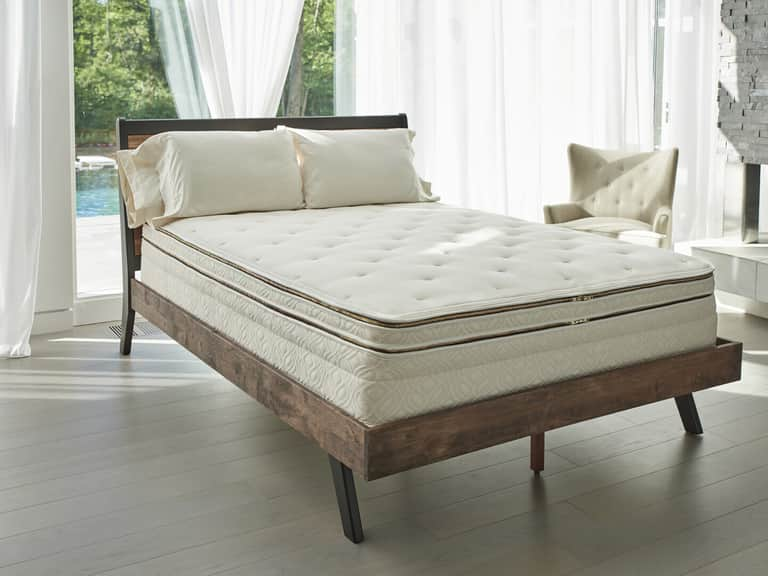
For a concrete example of Dunlop latex in a larger construction, the Naturepedic Arcadia Hybrid Organic Mattress is described as having six inches of organic Dunlop latex above six inches of organic wrapped coils, with a wool blend layer and a zippered cotton cover. Its listed construction illustrates how latex can work alongside coils and other materials; it does not establish that this design, or Dunlop latex generally, will suit every sleeper.
Temperature, movement, and everyday comfort
Some shoppers compare latex because they are interested in a responsive alternative to the slower, closer-contouring sensation often associated with certain foams. Latex is commonly described as buoyant, and some sleepers find that this makes position changes feel easy. But a material’s response alone does not predict how warm a mattress will feel. The cover, upholstery, room temperature, bedding, and individual sleep habits all play a part.
Nor should a description such as “breathable” be treated as a guarantee of a cool night. Mattress design and bedroom conditions are complex, and different people experience temperature differently. If temperature is a concern, look at the full construction and consider practical factors such as breathable bedding, room ventilation, and the amount of insulation from blankets and covers.
Motion transfer is another feature people sometimes associate with mattress materials. A responsive surface may feel lively under one person, but the complete bed determines how movement is shared across the mattress. In a hybrid, the coil system and its arrangement contribute to the overall response. Couples should evaluate the mattress together where possible and consider whether movement, firmness, and space feel comfortable for both sleepers.
A thoughtful checklist for choosing
Rather than deciding by process name alone, use a short list of questions to compare products consistently:
- What is the latex made from? Check whether it is described as natural, synthetic, or blended. Do not assume that “latex” or “Dunlop” automatically means organic.
- What firmness is offered? Look for the manufacturer’s firmness options and ask how they are defined. Labels can vary between brands.
- How thick is each layer? A layer’s depth influences how much it contributes to the overall feel.
- What sits beneath and above it? Read the full construction, including the base, coils, upholstery, and cover.
- Does the surface suit your position and preferences? Consider pressure relief, stability, and ease of movement together.
- Can you test it in realistic conditions? Review in-store testing or trial terms and make sure you understand the requirements.
- Are material claims clear? If a particular certification or sourcing standard matters to you, verify that the product documentation specifically identifies it.
This checklist is useful whether you are shopping for a mattress, a topper, or a latex pillow. The intended use changes the criteria: a topper modifies an existing sleep surface, while a mattress must work as a complete system. A pillow, meanwhile, needs to suit head and neck comfort in relation to the sleeper’s position and mattress.
Common assumptions worth setting aside
“Dunlop is always firmer.”
Not necessarily. Dunlop latex is often associated with a denser feel, but both Dunlop and Talalay are made in different firmnesses. Compare the actual specifications and, if possible, the sensation of the finished mattress.
“Talalay is always better for comfort.”
Comfort is personal. Some people enjoy Talalay’s buoyant response; others prefer the grounded feel they associate with Dunlop. A process name cannot tell you which one your body will prefer.
“A firm mattress provides more support.”
Firmness and support are not interchangeable. The goal is a surface that feels comfortable and stable for you, rather than the firmest option available. A poor match can feel uncomfortable regardless of the material.
“The latex layer determines the entire mattress.”
It contributes to the experience, but so do the base, other comfort materials, cover, and construction. A latex layer should be assessed as part of the whole bed.
So, Dunlop or Talalay?
Choose Dunlop if you are drawn to the possibility of a more substantial, grounded response—and if the specific mattress’s firmness and construction suit your needs. Consider Talalay if you are curious about a more uniform, buoyant sensation and prefer a surface that responds readily. These are tendencies to explore, not strict definitions or verdicts.
The most useful comparison is not “Which process wins?” but “Which complete sleep surface feels comfortable and supportive to me?” Start with your sleeping position and comfort preferences, then examine the materials, layer thickness, firmness options, and mattress design. If two products seem promising, compare them under similar conditions and allow enough time to notice the difference.
Sleep comfort is intimate and individual. Dunlop and Talalay offer two distinct ways of making latex foam, each with a range of possible constructions. Understanding those distinctions can make a product description more legible—but the best choice remains the one that feels right in the context of your body, your bed, and the way you rest.